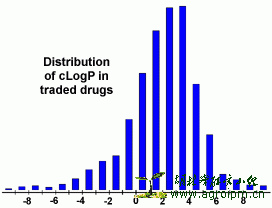
The logP value of a compound, which is the logarithm of its partition coefficient between n-octanol and water log(coctanol/cwater), is a well established measure of the compound's hydrophilicity. Low hydrophilicities and therefore high logP values cause poor absorption or permeation. It has been shown for compounds to have a reasonable propability of being well absorbt their logP value must not be greater than 5.0. The distribution of calculated logP values of more than 3000 drugs on the market underlines this fact (see diagram)
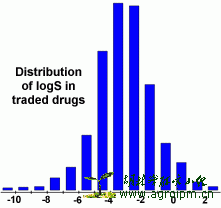
The aqueous solubility of a compound significantly affects its absorption and distribution characteristics. Typically, a low solubility goes along with a bad absorption and therefore the general aim is to avoid poorly soluble compounds. Our estimated logS value is a unit stripped logarithm (base 10) of the solubility measured in mol/liter.
In the following diagram you can see that more than 80% of the drugs on the market have a (estimated) logS value greater than -4.
While drawing a structure the toxicity risk predictor will start looking for potential toxicity risks as long as the currently drawn structure is a valid chemical entity. Toxicity risk alerts are an indication that the drawn structure may be harmful concerning the risk category specified. However, risk alerts are by no means meant to be a fully reliable toxicity prediction. Nor should be concluded from the absence of risk alerts that a particular substance is completely free of any toxic effect.
采用合适的培养基对成功分离和正确鉴定疫霉菌十分重要。许多疫霉菌的生长和产孢对培养基成份有特定的要求,例如一些疫霉菌在用于真...
来源于 《中国药典》2010版 《中国药品检验标准操作规范》 1乙二胺四醋酸二钠滴定液(0.05mol/L) 2乙醇制氢氧化钾滴定液(0.5mol/L或0.1mol/...
真菌的分布很广,有一部分可寄生在动物和植物体上引起真菌病害。在植物病害中,真菌病害的数量最多。作物上常见的病害如黑粉病,锈...

...