Antimicrobial metabolites produced by the plant growth-promo
发布日期:2025-11-22 22:16 浏览次数:
https://doi.org/10.1016/j.aac.2024.07.007
Abstract
Plant growth-promoting rhizobacteria (PGPR) such as Bacillus and
Pseudomonas have drawn broad attention and interest due to their agricultural benefits. One of the major benefits of PGPR lies at their biocontrol capabilities against various plant pathogens. The biocontrol capability of PGPR is closely related to its capability of producing various kinds of antimicrobial substances. Major antimicrobial secondary metabolites secreted by PGPR include non-ribosomal lipopeptides (NRLPs), polyketides, ribosomal peptides, phenazines, pyrrolnitrins, etc. This review focuses on the major antimicrobial secondary metabolites produced by Bacillus and
Pseudomonas including their classifications, structures, mechanisms of action and genetic regulations. We have also discussed their applications in plant biocontrol and provided insights into future development of improved biocontrol strains using synthetic biology approaches.
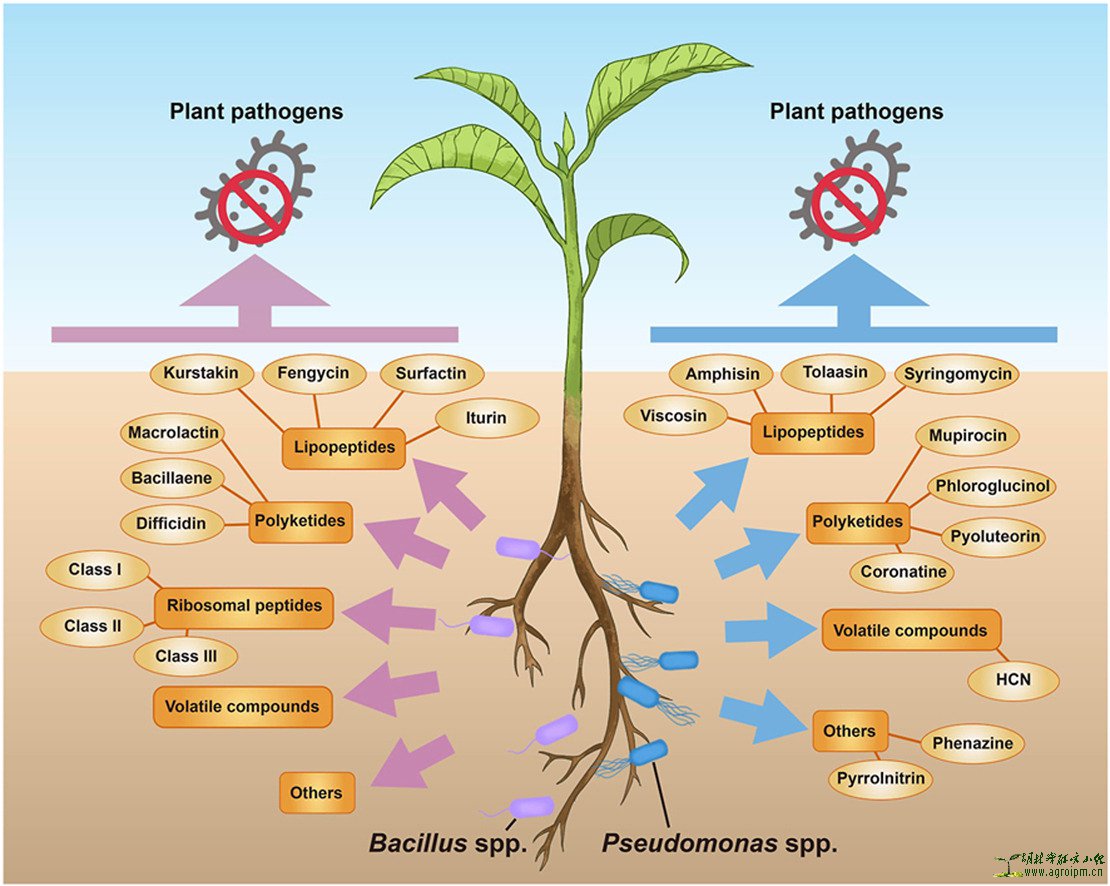 植物促生根际菌(PGPR)如芽孢杆菌属(Bacillus)和假单胞菌属(Pseudomonas)因其农业效益而受到广泛关注。PGPR的主要优势之一体现于其对多种植物病原体的生物防治能力。这种生物防治能力与其产生多种抗菌物质的能力密切相关。PGPR分泌的主要抗菌次级代谢产物包括:非核糖体脂肽(NRLPs)、聚酮化合物、核糖体肽、吩嗪类、吡咯尼群素等。本综述重点探讨了芽孢杆菌(Bacillus)和假单胞菌(Pseudomonas)产生的主要抗菌次级代谢产物,包括其分类、结构、作用机制(mechanisms of action)和遗传调控规律。同时分析了这些代谢产物在植物生防中的应用,并对通过合成生物学(synthetic biology)手段改良生防菌株的未来发展方向提出了见解。

