
发布日期:2012-12-14 08:43 浏览次数:
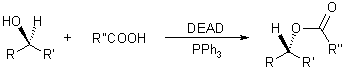

The Mitsunobu Reaction allows the conversion of primary and secondary alcohols to esters, phenyl ethers, thioethers and various other compounds. The nucleophile employed should be acidic, since one of the reagents (DEAD, diethylazodicarboxylate) must be protonated during the course of the reaction to prevent from side reactions.
Suitable nitrogen nucleophiles include phthalimide or hydrogen azide; subsequent hydrolysis (in the case of using phthalimide, see Gabriel Synthesis) or selective reduction (in the case of azide formation, see Staudinger Reaction) makes the corresponding amines accessible.
The triphenylphosphine combines with DEAD to generate a phosphonium intermediate that binds to the alcohol oxygen, activating it as a leaving group. Substitution by the carboxylate, mercaptyl, or other nucleophile completes the process.

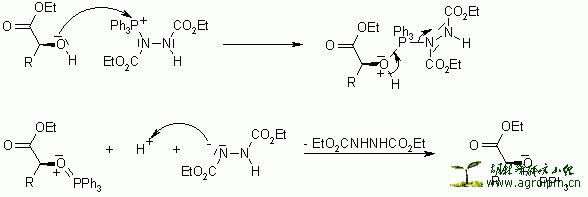
The reaction proceeds with clean inversion, which makes the Mitsunobu Reaction with secondary alcohols a powerful method for the inversion of stereogenic centers in natural product synthesis.

Side Reaction:
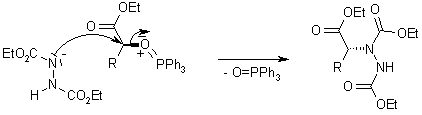
New protocols have been developed which allow better removal of side products and/or the conversion of more basic nucleophiles.
Recent Literature

Easily Prepared Azopyridines As Potent and Recyclable Reagents for Facile Esterification Reactions. An Efficient Modified Mitsunobu Reaction
N. Iranpoor, H. Firouzabadi, D. Khalili, S. Motevalli, J. Org. Chem., 2008, 73, 4882-4887.

Simplification of the Mitsunobu Reaction. Di-p-chlorobenzyl Azodicarboxylate: A New Azodicarboxylate
B. H. Lipshutz, D. W. Chung, B. Rich, R. Corral, Org. Lett., 2006, 8, 5069-5072.

Mitsunobu Approach to the Synthesis of Optically Active α,α-Disubstituted Amino Acids
J. E. Green, D. M. Bender, S. Jackson, M. J. O'Donnell, J. R. McCarthy, Org. Lett., 2009, 11, 807-810.

Fluorous Mitsunobu reagents and reactions
S. Dandapani, D. P. Curran, Tetrahedron, 2002, 58, 3855-3864.
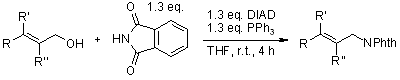
A convenient Two-Step Procedure for the Synthesis of Substituted Allylic Amines from Allylic Alcohols
S. E. Sen, S. L. Roach, Synthesis, 1995, 756-758.
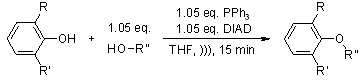
Use of Sonication for the Coupling of Sterically Hindered Substrates in the Phenolic Mitsunobu Reaction
S. D. Lepore, Y. He, J. Org. Chem., 2003, 68, 8261-8263.

Organocatalytic Mitsunobu Reactions
T. Y. S. But, P. H. Toy, J. Am. Chem. Soc., 2006, 128, 9636-9637.

Carbon Nucleophiles in the Mitsunobu Reaction. Mono and Dialkylation of Bis(2,2,2-trifluorethyl) Malonates
J. M. Takacs, Z. Xu, X.-T. Jiang, A. P. Leonov, G. C. Theriot, Org. Lett., 2002, 4, 3843-3845.

O-TBS-N-tosylhydroxylamine: A Reagent for Facile Conversion of Alcohols to Oximes
K. Kitahara, T. Toma, J. Shimokawa, T. Fukuyama, Org. Lett., 2008, 10, 2259-2261.

An Efficient, One-Pot Synthesis of S-Alkyl Thiocarbamates from the Corresponding Thiols Using the Mitsunobu Reagent
D. Chaturvedi, N. Mishra, V. Mishra, Synthesis, 2008, 355-357.

Synthesis of N-H vinylaziridines: a comparative study
B. Olofsson, R. Wijtmans, P. Somfai, Tetrahedron, 2002, 58, 5979-5982.

Exploration of the Mitsunobu Reaction with Tosyl- and Boc-Hydrazones as Nucleophilic Agents
J. M. Keith, L. Gomez, J. Org. Chem., 2006, 71, 7113-7116.

Single-Step Process for the Reductive Deoxygenation of Unhindered Alcohols
A. G. Myers, M. Movassaghi, B. Zheng, J. Am. Chem. Soc., 1997, 119, 8572-8573.
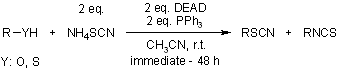
Conversion of Alcohols, Thiols, Carboxylic Acids, Trimethylsilyl Ethers, and Carboxylates to Thiocyanates with Triphenylphosphine/Diethylazodicarboxylate/NH4SCN
N. Iranpoor, H. Firouzabadi, B. Akhlaghinia, R. Azadi, Synthesis, 2004, 92-96.
